

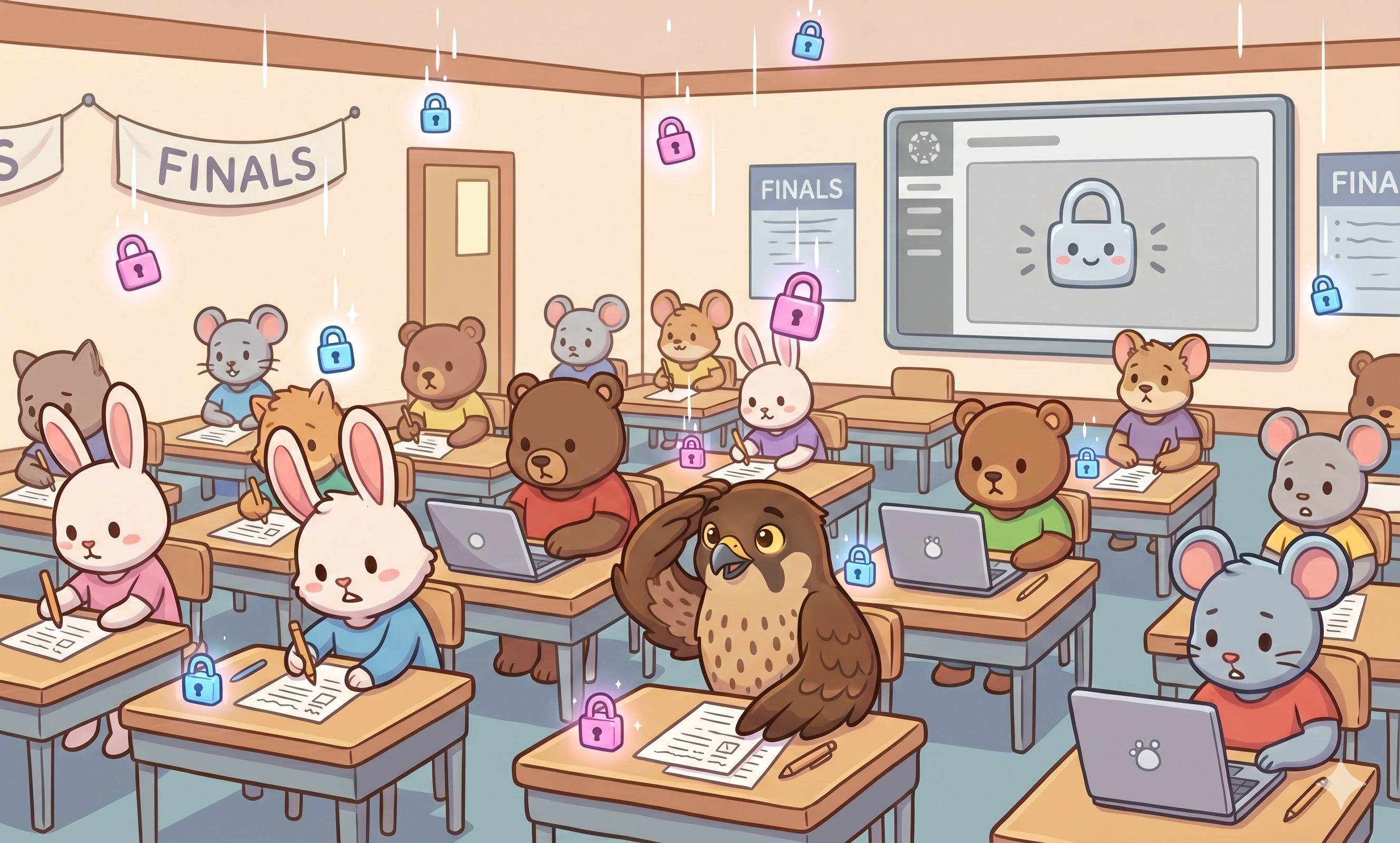
On May 7, 2026, at approximately 1:20 p.m. Pacific time, students logging into Canvas to submit final assignments found the login page had been replaced with a ransom demand. For 41% of higher education institutions in the United States, along with thousands more in the UK, Canada, Australia, and across Asia, the platform that held their coursework, grades, submissions, and communications was simply gone.
The timing was deliberate. Finals week is when a ransomware attack against an educational platform causes maximum damage. Deadlines cannot be moved. Grades cannot be submitted. Students who had spent a semester working toward specific outcomes had nowhere to turn. The attackers knew this, and they chose their moment accordingly.
How It Happened
ShinyHunters, a threat group with a long history of targeting data-rich platforms, first accessed Instructure's systems on April 25. The entry point was a vulnerability in Canvas's Free-For-Teacher accounts, publicly accessible accounts designed to let educators try the platform before institutional adoption. These accounts represented an internet-facing authentication surface that, once exploited, provided a path deeper into Instructure's infrastructure.
Instructure detected the intrusion on April 29 and engaged forensics teams. On May 2, the company confirmed that data had been stolen for ransom purposes. On May 6, one day before the ransomware message appeared, Instructure publicly claimed the situation was resolved.
It was not.
The May 7 attack deployed ransomware directly to the login page, taking Canvas offline at the worst possible moment for the 8,809 institutions that depend on it. By May 12, the ransom deadline had passed. By May 13, a class action lawsuit had been filed in the Southern District of California. The House Homeland Security Committee launched a formal investigation.
What Was Taken
ShinyHunters claimed approximately 3.65 terabytes of data covering roughly 275 million users: names, email addresses, student ID numbers, and private messages. Instructure disputed the most sensitive claims — passwords, government IDs, financial information, and birth dates were not compromised according to the company's own disclosure.
Whether or not the full 275 million figure holds up, the scope of institutions affected is not in dispute. UC system campuses, Arizona State, MIT, Oxford, the University of Melbourne — the list reads like a directory of the English-speaking world's major educational institutions.
The Vulnerability That Mattered
The Free-For-Teacher account vulnerability illustrates something broader than this specific breach.
Educational platforms face a structural tension: they need to be accessible. Students access Canvas from dormitories, libraries, coffee shops, and personal devices. Teachers log in from home. The entire value proposition of a cloud-based LMS depends on it being reachable from anywhere. That accessibility is also an attack surface.
Every endpoint that can be reached from the public internet by anyone can potentially be exploited by anyone. Free-For-Teacher accounts existed specifically to lower the barrier to access, which is exactly what an attacker looks for. Not the most hardened entry point, but the most open one.
Software-defined access controls are bounded by the software that implements them. When that software has a flaw, the controls fail. There is no architectural layer beneath them that holds.
What Institutions Can and Cannot Control
The Canvas breach makes something clear about what institutions can and cannot control.
Institutions that use Canvas cannot control Instructure's internal security. They made a decision to depend on a third-party platform, and when that platform was compromised, their students' data went with it. Vendor risk in cloud infrastructure is real, and this breach is a textbook example of it materializing at scale.
What institutions can control is their own network infrastructure. The connections between campus buildings, the links between satellite campuses and administrative offices, the remote access their staff use to reach internal institutional resources — these are not managed by Instructure. They are owned and operated by the institution itself.
And this is where the architectural question becomes relevant. If those connections are secured through software-defined access controls, VPNs, cloud-managed networks, credential-based access systems, then they carry the same structural fragility that the Canvas breach exposed. A compromised credential, a software vulnerability, an exploited account type that was never meant to be a security perimeter, and the institutional network is exposed in the same way Canvas was.
Hardware-enforced network connectivity removes that layer of fragility from the infrastructure that institutions actually own. The network link between your main campus and your satellite location does not have an authentication endpoint that can be exploited. There is no software vulnerability that grants access to it. The physical devices that create the connection were cryptographically paired at manufacture, and that pairing cannot be replicated by anyone who does not have the hardware.
The Ransomware Model
The Canvas attackers did not immediately encrypt and ransom. They staged the attack over weeks: initial access on April 25, data exfiltration over the following days, a false resolution claimed by Instructure, then the ransomware payload deployed at maximum impact.
This is now the standard playbook. Attackers do not rush. They establish persistence, harvest data, identify the moment when disruption causes the most pain, and then deploy. The double-extortion model maximizes leverage: we have your data, and we have taken your systems offline. Institutions face simultaneous pressure to restore operations and prevent data release, and the two threats may require different responses.
Education is a particularly attractive target because the operational stakes are high and the security investment is typically low. A mid-sized university is not a bank. It does not have a security operations center monitoring network behavior around the clock. It has IT staff managing a sprawling infrastructure with limited resources. When a platform that 40% of the sector depends on goes down during finals week, the pressure to pay is enormous.
ShinyHunters understood this. The May 7 timing was not a coincidence. It was a calculated decision about when institutions would be least able to absorb the disruption.
What Comes Next
The class action filed on May 13 will not be the last. With 275 million affected users across multiple jurisdictions, each with its own data protection requirements, the legal exposure for Instructure is substantial. The House Homeland Security Committee investigation signals that regulatory scrutiny of edtech security is coming.
For institutions, the near-term work is practical: triage which student data was exposed, prepare required notifications, review cyber insurance coverage, and evaluate whether their dependence on any single platform represents acceptable concentration risk.
The longer-term question is harder. Educational technology platforms are not going away. The operational benefits of a centralized LMS are real. But the Canvas breach demonstrates what happens when 41% of an entire sector's critical infrastructure runs through a single point of failure, and that point of failure has a software vulnerability in a publicly accessible account type.
The answer is not to abandon cloud platforms. It is to be honest about what they can and cannot protect, and to make sure that the infrastructure you do own and control is secured at a layer that does not share their weaknesses.
Sources: Fisher Phillips, Wikipedia: 2026 Canvas data breach
Interested in what Teleportal can do for your network?
Learn More